What Standards Govern Battery Plate Short Circuit Testing Procedures
2026-05-13 11:47Table of Contents
Why Battery Short Circuit Testing Matters in Everyday Life
When you use batteries in your phone, laptop, electric vehicle, or even children's toys, you're relying on safety systems that prevent catastrophic failures. Battery short circuits can happen due to manufacturing defects, physical damage, or aging components. These failures aren't just inconvenient—they can cause fires, explosions, and serious injuries. The batteries powering your devices undergo rigorous short circuit testing to ensure they won't fail dangerously under unexpected conditions. This testing simulates what happens when positive and negative plates accidentally connect, creating a direct path for electricity to flow uncontrollably. Understanding these safety measures helps you make informed choices about the batteries you use daily and recognize why certified batteries matter for your family's safety.
Key Standards You Should Know About
Several international and national standards govern how battery short circuit testing must be performed. The most widely recognized include IEC 62133 for international markets, UL 1642 for North American certification, and GB 31241-2014 for Chinese markets. These standards share common requirements but have specific variations in testing conditions. The UN38.3 standard is particularly important for batteries transported by air, as it's mandated by international aviation authorities. All these standards aim to answer one critical question: will the battery remain safe if its internal plates accidentally short circuit? Manufacturers must test their batteries according to these protocols before products reach consumers. When you see certification marks from these standards on battery packaging, you can trust that independent testing has verified the battery's safety under short circuit conditions.
What Happens During a Short Circuit Test
The testing process follows a precise scientific methodology. First, batteries are fully charged to their maximum capacity, simulating real-world usage conditions. They're then stabilized at specific temperatures—typically 55±2°C for elevated temperature tests or 20±5°C for room temperature tests. The actual short circuit is created by connecting the positive and negative terminals with a controlled resistance, usually 80±20mΩ. This resistance simulates real-world short circuit conditions rather than creating a perfect zero-resistance connection. The test continues for a specified duration, often 24 hours or until certain conditions are met. Throughout the test, monitoring equipment tracks critical parameters: short circuit current, battery surface temperature, and any signs of thermal runaway. The battery must withstand this stress without catastrophic failure to pass certification requirements.
Understanding Safety Thresholds and Results
Batteries pass short circuit tests when they meet specific safety thresholds. The most critical requirement is that the battery must not catch fire or explode during testing or for six hours afterward. Temperature limits are equally important: the external case temperature typically must not exceed 170°C according to UN38.3 requirements, though some standards like UL 1642 set the limit at 150°C. The battery should not rupture, disassemble, or leak hazardous materials. These thresholds represent the boundary between safe failure and dangerous thermal runaway. When a battery passes these tests, it demonstrates robust internal construction, effective safety mechanisms, and stable chemistry. For consumers, this means the battery has built-in protections that activate during abnormal conditions, giving you precious time to react if something goes wrong with your device.
What to Look for in Testing Equipment
Professional testing equipment must meet rigorous specifications to ensure accurate, repeatable results. Key features include adjustable testing voltage up to 2000V to accommodate different battery types, precise current measurement capabilities, and temperature monitoring systems. The equipment should offer programmable test sequences that automatically follow standard protocols, eliminating human error. Safety features are paramount: explosion-proof enclosures, emergency stop mechanisms, and proper ventilation systems protect operators during potentially hazardous tests. Look for equipment with data logging capabilities that create detailed test reports for certification purposes. The best systems balance automation with flexibility, allowing technicians to customize tests while maintaining compliance with international standards. Proper testing equipment represents the foundation of battery safety verification.
Recommended Solution: Automatic Short Circuit Testing Machine
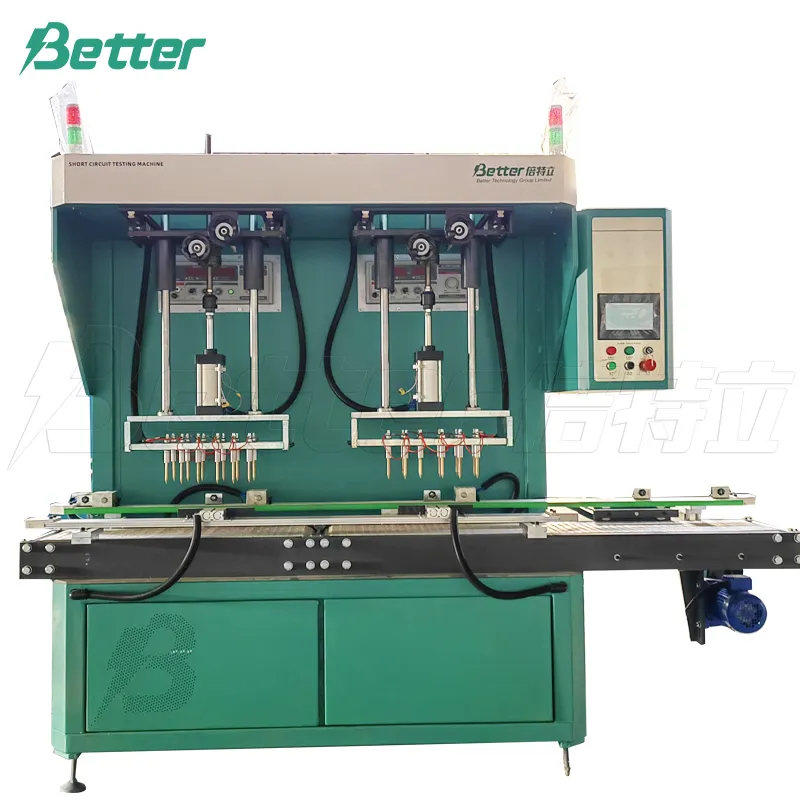
For reliable battery plate short circuit testing, the Automatic Short Circuit Testing Machine offers comprehensive capabilities for 32Ah to 200Ah automotive batteries. This system features fully automated operation with photoelectric sensors that position batteries precisely before testing probes descend to perform insulation and short circuit checks between positive and negative plates in each cell. The machine delivers 150 tests per hour with high accuracy through pulse high voltage technology and sensitive breakdown current detection. Its adjustable testing voltage from 0-2000V accommodates various battery specifications while maintaining consistent performance. The system automatically separates qualified batteries from defective ones, pushing unqualified units to a rejection table with alarm signals. Built with industrial-grade components including Mitsubishi PLC/HMI controls and high-voltage controllers, this machine provides the precision and reliability needed for certification testing. For manufacturers requiring consistent, standards-compliant short circuit verification, this automated solution reduces human error while increasing throughput and safety.