What Is a Lead Strip Production Line
2026-03-24 16:11Table of Contents
Lead-Acid Batteries and Their Everyday Applications
Lead-acid batteries keep many essential systems running smoothly in daily life and work. They start car engines, keep computers online during power cuts, and store energy from solar panels for later use. These batteries stand out for their balance of cost and capacity, making them a practical choice for vehicles, backup power setups, and off-grid installations. Yet users often run into the same frustrations: a battery that drains faster than expected or fails to hold a charge after a few years. These issues usually start long before the battery reaches the end user, during the manufacturing steps that shape its core components.
At the heart of every lead-acid battery lies a set of plates that handle the chemical reactions needed to store and release electricity. The quality of those plates directly affects how well the battery performs over time. Manufacturers focus on precise processes to build plates that resist wear and deliver steady power. One critical early step involves turning raw lead into thin, uniform strips that form the backbone of those plates. This is where a lead strip production line comes into play, turning basic materials into the foundation for dependable battery performance.
How Battery Plates Are Made and Why Grids Matter
Battery plates consist of two main parts: a metal grid and a paste applied on top. The grid acts as the structural frame and electrical conductor inside each lead-acid battery. It must conduct current evenly while supporting the active material that participates in the charge-discharge cycle. Any weakness in the grid can lead to uneven reactions, heat buildup, or early breakdown of the entire plate.
Grids start as flat lead material shaped into a lattice pattern. The material needs the right thickness, strength, and surface finish so the paste sticks properly and the current flows without resistance. Poor grid quality shows up later as reduced capacity or shorter service life in the finished battery. For this reason, battery makers pay close attention to the initial material preparation. Lead strips provide the raw stock that gets further processed into these grids, either by expanding the strip or punching it into the final grid shape. The consistency of the strip sets the stage for everything that follows in battery assembly.
The Role of Lead Strips in Creating Reliable Battery Grids
Lead strips serve as the starting material for most modern grid production in lead-acid battery manufacturing. The strip is a continuous ribbon of lead alloy, rolled or cast to precise dimensions before it moves on to grid forming. Its thickness, width, and surface quality determine how well the final grid will perform inside the battery. A well-made strip allows the grid to resist corrosion from the sulfuric acid electrolyte and maintain strong contact with the pasted active material.
In the battery, the grid carries current across the entire plate. If the strip used to make it varies in thickness or contains impurities, some areas of the grid may corrode faster or conduct electricity less efficiently. Over repeated cycles, this leads to higher internal resistance and faster loss of capacity. Lead strips also influence how evenly the paste adheres during the pasting step. Uniform strips reduce the risk of gaps or weak spots that could cause active material to shed prematurely. For anyone working with batteries, whether in maintenance or production, understanding this early link helps explain why some batteries simply outperform others under the same conditions.
Challenges Battery Manufacturers Face with Lead Strip Quality
Producing lead strips that meet tight specifications is not straightforward. Molten lead must be handled at high temperatures, then cooled and shaped without introducing defects. Variations in cooling rates can create uneven thickness, while air pockets or impurities may weaken the final material. Battery manufacturers need strips that stay within narrow tolerance ranges so downstream grid forming and pasting steps run smoothly.
Another common hurdle involves material waste. Scrap from trimming or defective sections adds up quickly if the process lacks efficient recovery systems. Labor-intensive manual adjustments also slow down output and raise costs. In a competitive battery market, these inefficiencies directly affect pricing and reliability of the finished product. Manufacturers therefore look for production methods that deliver repeatable results with minimal variation. Consistent strip quality reduces the chance of downstream problems such as grid corrosion or active material shedding, issues that shorten battery life and frustrate end users who depend on steady power.
What a Lead Strip Production Line Actually Involves
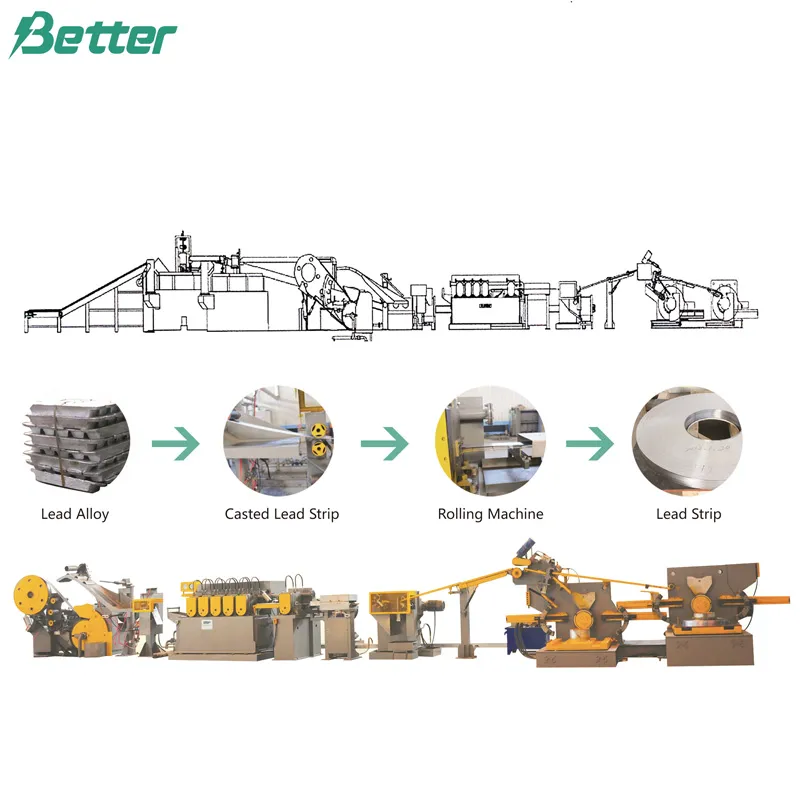
A lead strip production line brings together several integrated steps to turn raw lead into finished coils ready for grid making. It begins with melting lead ingots in a controlled pot, followed by feeding the molten metal into a casting unit. The casting creates a raw strip of standard dimensions that then passes through rolling stations to reach the final thickness required for battery grids. After rolling, the strip is dried, trimmed to the correct width, and coiled automatically for easy transport to the next stage of battery production.
The entire line runs under automated control to keep every parameter steady. Sensors monitor temperature, speed, and thickness in real time, allowing quick corrections without stopping the flow. Scrap pieces cut from the start or end of each run drop into a recovery system that returns them directly to the melting pot. This closed-loop approach keeps waste low and maintains high output rates. For battery makers, such a line simplifies the supply of consistent material and supports tighter quality control across the whole manufacturing process.
How a High-Efficiency Lead Strip Production Line Operates
Modern lead strip production lines combine melting, continuous casting, precision rolling, and automatic recoiling into one streamlined system. The process starts at the lead pot where ingots melt and flow into a holding tank. From there, molten lead enters the casting machine, forming a raw strip typically 80 mm wide by 8 mm thick. This raw strip moves immediately to a series of rolling stations—usually six roughing pairs followed by a finishing pair—that compress it to the exact gauge needed for grid production.
After rolling, air blowers remove any residual emulsion, and trimming knives cut the edges to the final width while a cutter handles any scrap. Twin recoiler units automatically switch between coils so production never pauses. Advanced PLC controls oversee every station, ensuring uniform speed and tension throughout. The built-in scrap recovery system sends all offcuts straight back to the melt, minimizing losses. This setup delivers high production speed while keeping the strip surface clean and dimensions precise, ready for immediate use in expanding or punching operations that create the final battery grids.
Why Consistent Lead Strips Improve Battery Life and Performance
Uniform lead strips lead to grids that distribute current evenly across each plate in a lead-acid battery. Even thickness prevents hot spots during charging and reduces the rate of grid corrosion in the acidic environment. Stronger grids also hold the active material more securely, lowering the chance of shedding that gradually reduces capacity. These improvements translate into batteries that maintain their rated performance longer and recover better from deep discharges.
End users benefit directly through fewer unexpected failures in cars, UPS systems, or solar storage setups. Manufacturers gain from smoother production runs and lower rejection rates at final testing. Consistent strips also support tighter control over paste application, which further enhances the electrochemical efficiency inside the battery. In short, investing in reliable lead strip production pays off in batteries that simply work better and last longer under real-world conditions.
When it comes to equipping a lead-acid battery manufacturing operation with dependable tools, the Lead Strip Production Line stands out for its integrated design and practical advantages. It combines lead melting, continuous casting, precision rolling, and automatic recoiling under advanced PLC control, delivering uniform strip quality at high speeds while cutting material waste through an efficient scrap recovery system. Labor costs drop thanks to automation, and the eco-friendly layout helps operations stay sustainable. Battery producers looking to boost output consistency and reduce downtime will find this line a solid upgrade. Explore the full details and specifications at Lead Strip Production Line to see how it fits into your production workflow.