How Does a Punching Machine Work in Battery Production
2026-05-06 16:22Table of Contents
Why Battery Quality Matters in Everyday Life
Batteries power so much of what we do every day—from starting our cars in the morning to keeping phones, laptops, and home energy storage systems running smoothly. When they underperform, it creates real headaches: a dead car battery leaves you stranded, a phone that dies too quickly disrupts work, and unreliable storage in solar setups means higher electricity bills or lost power during outages.
Most people don’t think about the manufacturing process behind these batteries until problems appear. Understanding how key components are made can help you choose better products and troubleshoot issues more effectively. One critical step in lead-acid battery production is creating the grid that holds everything together, and that’s where punching machines play a central role.
This article walks through practical battery knowledge, common frustrations, and how precise manufacturing—like with a punching machine in battery production—directly affects the batteries you rely on.
Common Battery Issues People Face
Users often deal with batteries that drain faster than expected, lose power in cold weather, or fail to hold a charge after a couple of years. In vehicles, this might show up as slow cranking or complete failure on cold mornings. For home or industrial energy storage, it can mean reduced capacity or inconsistent output.
These problems frequently trace back to the internal structure of the battery. The grid, which supports the active material (the paste that stores and releases energy), needs to be strong, corrosion-resistant, and consistent. Poor grid quality leads to material shedding, uneven current distribution, and shorter lifespan.
Another frequent complaint is swelling or leakage, often linked to manufacturing inconsistencies that allow impurities or weak structural support. In daily use, people also notice performance drops after deep discharges or in high-temperature environments—common in regions with hot climates or heavy industrial use.
Knowing these pain points helps when evaluating batteries. Look for manufacturers who invest in precise production techniques that minimize defects and maximize uniformity.
The Role of Grids in Battery Performance
The grid is the metal framework inside a lead-acid battery plate. It conducts electricity and holds the active paste in place during repeated charge and discharge cycles. A well-designed grid distributes current evenly, resists corrosion, and maintains structural integrity over time.
Without a strong grid, active material can flake off, reducing capacity and causing internal shorts. This is why grid manufacturing quality is so important for long-term reliability. Modern processes aim for lightweight yet durable grids with precise dimensions to optimize material use and performance.
In battery production, the choice of grid-making method—such as punching—significantly impacts these outcomes. Punched grids often provide better consistency compared to older casting methods, leading to improved conductivity and longer service life.
How a Punching Machine Works in Battery Production
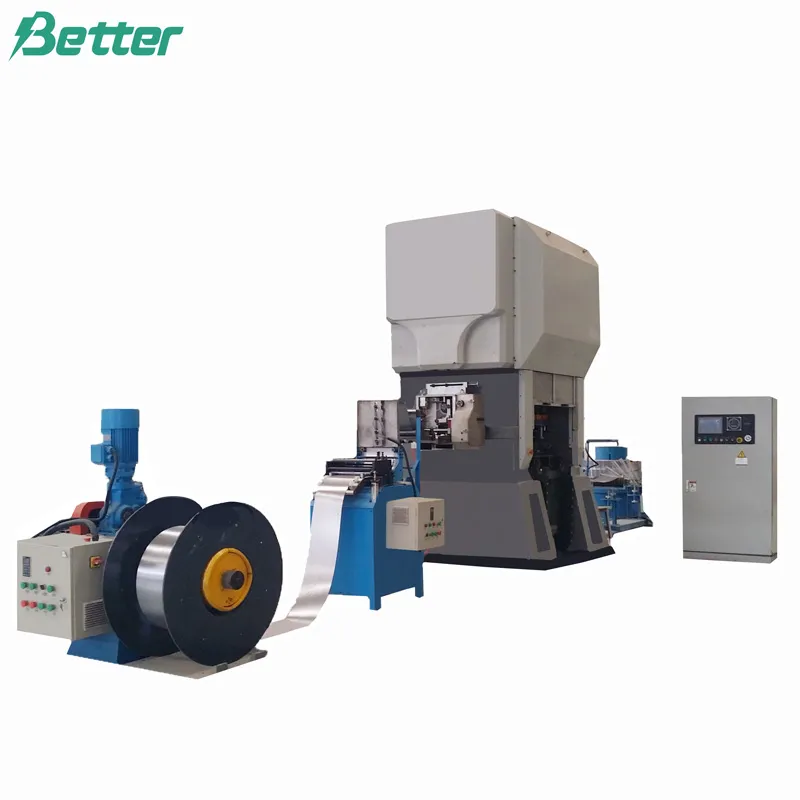
A punching machine in battery production transforms flat lead strips into intricate grid patterns used for battery plates. The process starts with high-quality lead alloy strips, typically 70 to 340 mm wide and 0.7 to 1.2 mm thick. These strips are fed into an automated line that handles multiple steps efficiently.
First, the strip goes through unwinding and welding sections to ensure continuous feed without interruptions. A leveling and buffering unit then flattens the material and maintains proper tension, removing any kinks that could cause defects.
Next, a precise feeder advances the strip into the press area at the right timing. The heart of the operation is the press equipped with a custom punching mold. It stamps out the grid design—creating the lattice structure with lugs and frames—at high speeds, often 170 to 220 punches per minute. This produces grids with maximum continuous panel widths around 320 mm and individual grid widths up to 150 mm.
After punching, the grids are wound or moved to pasting stations where active material is applied. The entire line can run at linear speeds of 28 to 35 meters per minute, making it suitable for high-volume production while keeping tight tolerances.
Precision is critical here. Accurate punching ensures uniform grid thickness and wire dimensions, which directly affects how well the paste adheres and how evenly current flows. ±0.05 mm pasting uniformity is a benchmark many quality operations target, reducing the risk of weak spots that lead to early failure.
This automated approach minimizes waste, lowers labor needs, and delivers repeatable results—key advantages over manual or less advanced methods. For manufacturers serving global markets, including BRICS countries and Belt and Road regions, such efficiency helps control costs while meeting high standards.
Key Factors for Reliable Battery Manufacturing
Beyond the punching step, overall battery quality depends on several linked processes. Material selection matters—high-purity lead alloys resist corrosion better. Consistent pasting and curing ensure the active material stays securely in the grid.
Users should pay attention to these when selecting batteries: check for manufacturers with strong quality certifications like ISO9001 and a track record of innovation. Patents and industry memberships often signal commitment to better processes.
In practice, well-made batteries handle daily stresses—like frequent cycling in backup power systems or vibration in vehicles—more effectively. They maintain capacity longer and perform reliably across temperature ranges.
For businesses in battery production or those sourcing equipment, investing in advanced machinery reduces defects and improves output consistency, which ultimately benefits end users.
Choosing Better Equipment for Long-Term Results
When production equipment performs well, the resulting batteries are more dependable for everyday needs. The Punching Line Machine from Better Technology Group Limited stands out for its high-speed automation, reaching up to 35 m/min linear speed and 220 punches/min. It delivers excellent precision with ±0.05 mm pasting uniformity and accurate cutting, integrating multiple processes into one efficient line.
This equipment supports comprehensive battery manufacturing solutions, helping producers create higher-quality lead-acid grids with less waste and greater reliability. Its design emphasizes durability and ease of operation, backed by over 30 years of industry experience and strong technical support.
For companies looking to upgrade or set up production lines, this punching line machine is a solid choice that translates into better-performing batteries for customers worldwide. It aligns with customer-centric approaches focused on practical, long-lasting results.