What Is Battery Gel Filling and Why Is It Important
2026-06-10 16:03Table of Contents
What Is Battery Gel Filling?
You've likely heard of lead-acid batteries, the workhorses powering everything from your car to backup systems for computers and hospitals. Inside these batteries, there's a critical component: the electrolyte. In traditional batteries, this is a liquid acid. Battery gel filling is a different, more advanced approach. Instead of a free-flowing liquid, a special silica-based compound is added to the electrolyte, turning it into a thick, stable gel. This gel is then precisely injected or "filled" into the battery cells in a controlled manufacturing process. Think of it as the difference between pouring water into a sponge versus pouring water into an open cup. The gel saturates the battery's internal plates but remains immobilized. This fundamental change in the electrolyte's physical state is what unlocks a host of benefits that directly address common battery headaches in daily life and work.
Why Gel Filling Matters for Your Battery
So, why should you care about a technical process like gel filling? Because the problems it solves are the very ones that cause frustration, expense, and downtime. Traditional liquid lead-acid batteries have limitations. They need to be kept upright to prevent leaks, the liquid can evaporate over time requiring maintenance, and they are more susceptible to damage from vibration. In contrast, a properly manufactured gel battery tackles these issues head-on. The immobilized gel electrolyte cannot spill, even if the battery case is cracked or placed on its side. This makes them inherently safer and more versatile for installation. There is also no liquid to evaporate, which means they are truly maintenance-free; you never need to check or top up fluid levels. Furthermore, the gel structure better supports the internal plates, making the battery more resistant to vibrations and shocks, a key factor for applications in vehicles or mobile equipment. Most importantly for backup power, gel batteries have a much lower self-dcharge rate, meaning they can sit idle for much longer periods and still be ready to deliver full power when the main electricity fails. This reliability is crucial when the power goes out, whether you're protecting home office equipment or critical industrial machinery.
Common Concerns About Gel Filled Batteries Answered
When considering gel batteries, several practical questions often come up. People wonder about their lifespan, cost, and suitability. Generally, gel batteries offer a longer service life and can withstand more charge-discharge cycles compared to standard liquid batteries of similar size, especially when they are not regularly deeply discharged. This makes the higher initial cost a long-term investment for many users. A key point of confusion is charging. Gel batteries require a specific charging profile, with slightly lower voltage limits than flooded batteries. Using a standard charger not designed for gel chemistry can overcharge and permanently damage the battery. Therefore, ensuring you have a compatible charger or a charger with a selectable gel mode is essential. Temperature is another factor. While gel batteries perform well across a range, extreme heat can shorten the life of any battery, and extreme cold can temporarily reduce available power. For most common applications like solar energy storage, UPS systems for computers and servers, medical devices, electric scooters, and marine use, the advantages of safety, maintenance-free operation, and installation flexibility make gel batteries a superior choice despite the upfront cost.
A Closer Look at the Solution: Automatic Gel Filling Machines
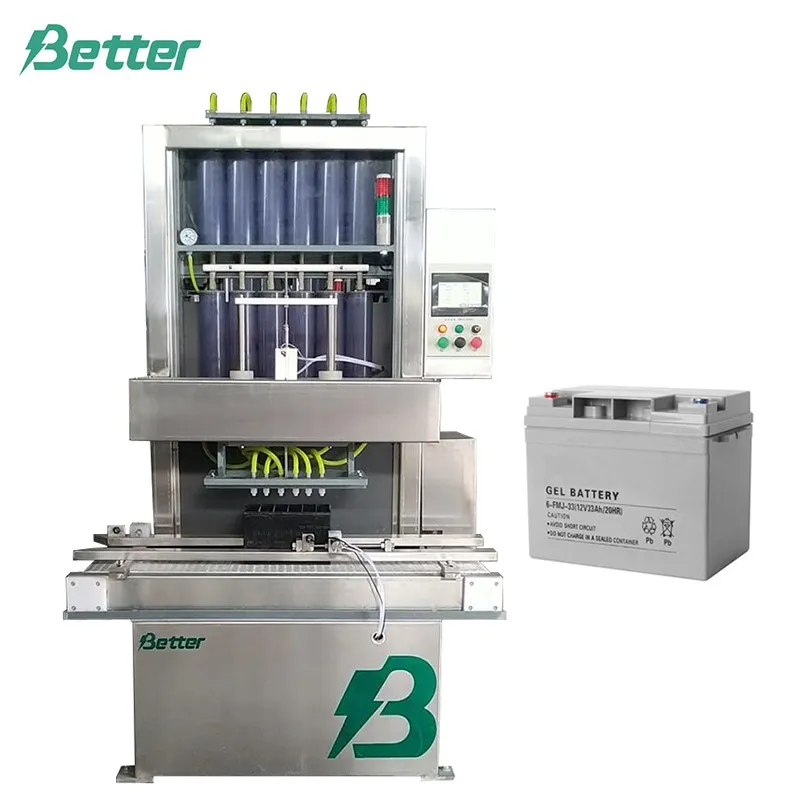
The quality and consistency of a gel battery are fundamentally determined during the manufacturing stage, specifically during the gel filling process. Inconsistent or imprecise filling leads to weak cells, reduced capacity, and shorter overall battery life. This is where professional-grade automatic gel filling machines become critical. For businesses producing or maintaining batteries, investing in the right equipment is an investment in end-product quality. A machine like the Automatic Gel Filling Machine is engineered for this precise task. It is designed for the vacuum filling of gel into batteries, typically in the 12V 40Ah to 200Ah range common for UPS and backup power applications. Its operation is centered on precision and repeatability. The machine uses a numerical control quantitative method, where a rotary encoder automatically adjusts the measuring cylinder to ensure the exact same amount of gel is dispensed every time, with a high filling accuracy of ±1% F.S. (Full Scale) per nozzle. It handles batches efficiently with six nozzles, each capable of dispensing 200-2000ml at a speed of 1000ml/min. The process is automated: a sensor detects the battery, and the system completes quantification, vacuum, filling, and circulation. For manufacturers, features like the integrated mixing system keep the gel homogeneous, and the ability to manually adjust nozzle positions and set fill volumes via the HMI allows for flexible switching between different battery models. The machine's robust build with a 316L stainless steel frame and high-quality components from brands like MITSUBISHI (PLC/HMI) and Schneider ensures reliability for continuous industrial use.
In summary, for anyone relying on battery power where safety, low maintenance, and reliability are non-negotiable, gel-filled batteries present a compelling solution. Their performance is a direct result of precise manufacturing. The Automatic Gel & Filling Machine exemplifies the technology that makes this possible. It guarantees the consistency and accuracy vital for high-quality gel battery production through its数控定量 (CNC quantitative) system, vacuum-assisted filling for complete penetration, and automated workflow. The use of durable, corrosion-resistant 316L stainless steel and reputable industrial controls from Mitsubishi and Schneider translates to long-term operational stability and minimal downtime. If your goal is to produce or maintain backup power batteries that users can install and forget about until they are needed, ensuring the core gel filling process is handled by equipment of this caliber is a decisive step. This machine is a strong recommendation for manufacturers seeking to enhance product quality, optimize their production line for popular UPS battery models, and build a reputation for reliability that starts on the factory floor.