What is Battery Enveloping and Why It Matters
2026-03-02 14:58Table of Contents
1. Understanding Battery Enveloping
2. Role of Separators in Batteries
3. How Battery Enveloping Works
4. Separator Materials Used
5. Why Proper Enveloping Matters
6. Common Challenges in Enveloping
7. Manual Versus Automated Processes
8. Key Factors for Success
9. Future of Battery Enveloping
Understanding Battery Enveloping
Battery enveloping forms a core step in lead-acid battery assembly. Technicians or machines place electrode plates—most often the positive ones—inside porous separator sheets that fold and seal around them like a pocket or envelope. This creates a barrier between positive and negative plates while letting electrolyte flow freely.
In everyday battery production lines, the enveloping process directly affects how reliably the finished battery performs. Whether you build automotive starting batteries, backup power systems, or industrial storage units, getting battery enveloping right means fewer defects reaching the end customer. People searching for answers on battery enveloping usually want to know why their production yield drops, why short circuits appear during testing, or how to scale output without sacrificing quality.
The term battery enveloping, also called separator enveloping or plate enveloping, describes this specific wrapping technique used across flooded, AGM, and gel lead-acid technologies. It is not the same as simple stacking or winding in lithium-ion cells, but the principle of insulation remains central.
Role of Separators in Batteries
Separators keep positive and negative plates from touching while allowing ions to move during charge and discharge. Without them, direct contact would cause immediate short circuits and destroy the battery. In the enveloping process, the separator material wraps one plate completely on three or four sides, forming a pocket that contains active material and reduces shedding.
This pocket design also improves vibration resistance—important for vehicle batteries that face constant road shocks. Good separator enveloping keeps the electrolyte evenly distributed and minimizes internal resistance, which translates to better cranking power and longer service life in real-world use.
For production teams, understanding this role helps spot quality issues early. If you see uneven plate alignment or torn separators on the line, the root cause often traces back to how the enveloping step was handled.
How Battery Enveloping Works
The process starts with prepared plates moving along a conveyor. Operators or automated feeders load plates into the machine. Separator material, supplied from rolls, feeds into folding stations where it wraps around each plate. Heat sealing or ultrasonic welding closes the open edges, creating a secure envelope. For AGM types, the machine may add compression and stacking in the same cycle.
Next comes alignment. The enveloped plates must line up precisely with opposing plates before group assembly. Any shift larger than a couple of millimeters can create weak spots or cause shorts later. Modern lines combine enveloping with side-lug brushing to remove loose powder, then stack and compress the groups ready for welding.
The entire sequence runs continuously in high-volume plants. Speed matters, but precision controls everything. A single misalignment in battery enveloping can scrap an entire plate group and slow the line.
Separator Materials Used
Two main types dominate production: polyethylene (PE) microporous separators and absorbent glass mat (AGM). PE offers thin, flexible pockets with high porosity for flooded batteries. AGM uses thicker glass-fiber mats that absorb electrolyte completely, suiting maintenance-free designs and providing better recombination efficiency.
Some lines handle fiberglass composites or hybrid materials. The choice affects how the enveloping machine runs—PE needs different tension settings than AGM to avoid tears or wrinkles. Switching materials without downtime requires equipment with dual unwinding systems that let operators change rolls independently.
Material thickness, porosity, and backweb design all influence final battery performance. Teams that match separator type carefully to their battery specs see higher first-pass yields and fewer field failures.
Why Proper Enveloping Matters
Proper battery enveloping directly impacts safety and longevity. Enveloped plates reduce the chance of active material migrating and causing micro-shorts over time. This means batteries hold charge longer and resist sulfation better in partial-state-of-charge applications like stop-start vehicles.
In manufacturing, consistent enveloping cuts scrap and rework. It also supports tighter tolerances in plate-group thickness, which helps automated welding stations run smoothly. Down the line, better enveloping leads to batteries that pass vibration, cycle-life, and high-rate discharge tests more reliably.
For users downstream—fleet managers, UPS installers, or solar installers—reliable enveloping means fewer warranty claims and more predictable performance. When production skips corners on separator enveloping, the problems show up months or years later as premature capacity loss or sudden failure.
Common Challenges in Enveloping
Manual enveloping still exists in smaller shops, but it brings high labor costs, operator fatigue, and inconsistent results. Workers may insert plates at slightly different angles, creating gaps or wrinkles that later cause shorts. Dust from plate handling adds another layer of difficulty, affecting both health and product cleanliness.
Even automated lines face issues. Material feed tension that drifts can tear separators. Plate thickness variations require constant adjustment. High-speed runs amplify small errors— one misfed plate can jam the machine and halt output for minutes.
Scrap rates above 1% quickly eat into margins. Alignment tolerance problems show up during final assembly when groups refuse to fit cleanly into cases. These pain points drive many manufacturers to look for better ways to handle battery enveloping.
Manual Versus Automated Processes
Manual methods work for low-volume or prototype runs, but they cannot match the repeatability of machines. Automated separator enveloping systems load plates from two workstations, fold and seal separators at consistent tension, and stack groups with programmable compression. This reduces human error and lets one operator oversee multiple lines.
The speed difference is striking. Well-tuned automated equipment handles dozens of plates per minute while keeping scrap below 0.5%. It also integrates lug brushing and heat shrinking in one flow, cutting handling steps that introduce contamination or misalignment.
Transitioning to automation solves labor shortages and improves traceability. Sensors log every envelope cycle, making it easier to trace defects back to specific parameters. For growing B2B operations, the shift from manual to automated battery enveloping often becomes the turning point for scaling production profitably.
Key Factors for Success
Success in battery enveloping depends on four main areas: equipment precision, material quality, process control, and operator training. Machines need servo-driven feeders for exact positioning and robust PLC systems that adjust in real time. Separators must arrive with consistent thickness and porosity—no variation that surprises the line.
Process parameters such as sealing temperature, folding pressure, and stacking force require careful tuning for each plate size. Regular maintenance on vacuum systems and cutting blades prevents sudden drops in quality. Training focuses on quick material changes and basic troubleshooting so small issues do not escalate.
When these factors line up, production runs smoothly, scrap stays minimal, and output meets demand without overtime. Teams that monitor key data points—like alignment after every shift—catch drifts early and keep the enveloping process stable day after day.
Future of Battery Enveloping
Industry trends point toward smarter, faster, and more flexible systems. Machines will integrate vision systems that inspect every envelope for wrinkles or tears before stacking. Predictive maintenance using sensor data will schedule servicing before breakdowns occur. Compatibility with a wider range of separator types and plate dimensions will let plants switch between battery models with almost no downtime.
Sustainability also plays a role—equipment that minimizes material waste and energy use fits the push for greener manufacturing. As demand for reliable lead-acid batteries continues in heavy-duty and renewable storage markets, advances in separator enveloping technology will remain central to meeting quality and volume targets.
Staying informed about these developments helps production engineers plan upgrades that keep their lines competitive for years ahead.
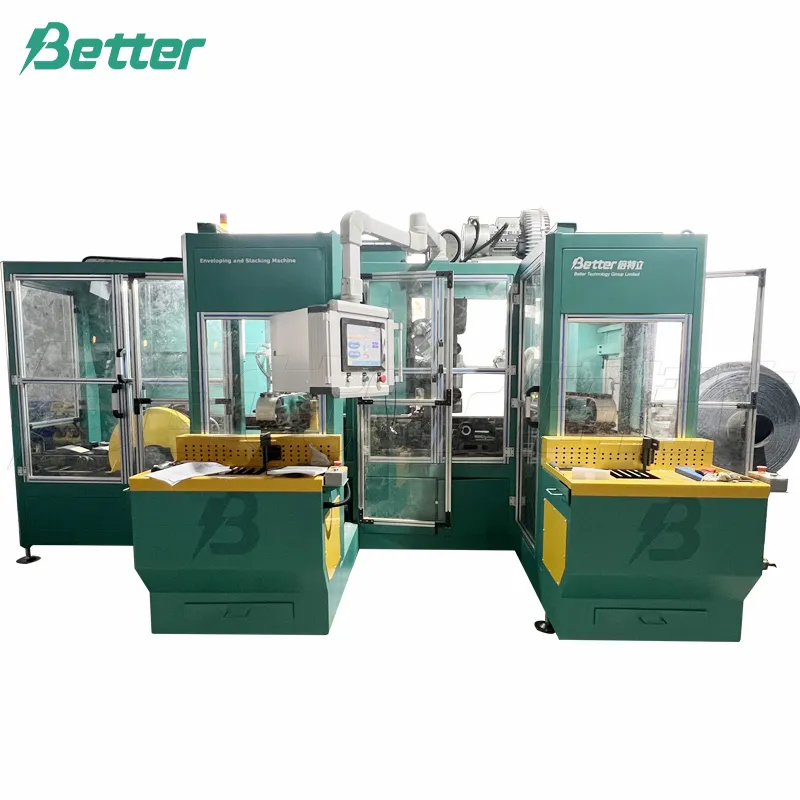
When looking for equipment that solves real production headaches in battery enveloping, the Separator Enveloper & Stacker from Better Technology delivers clear advantages. It handles both PE and AGM separators at speeds up to 150 pieces per minute for PE and 120 for AGM, with scrap and defect rates held to ≤0.1% and alignment tolerance within 2 mm. The machine combines enveloping, stacking, compressing, wrapping, and heat shrinking in one compact line, features dual unwinding for quick material changes, and uses proven components like Omron PLC and Panasonic servos for reliable day-in, day-out performance. Manufacturers serious about boosting output while slashing waste will find this solution worth a close look at Separator Enveloper & Stacker.