How to Prevent Short Circuits in Lithium Batteries
2026-03-16 15:38Table of Contents
1. Understanding Short Circuits in Lithium Batteries
2. Why Battery Plates Are Key to Short Circuit Prevention
3. Common Battery Plate Defects That Cause Issues
4. How to Control Contamination in Battery Plate Production
5. Aligning and Assembling Battery Plates Correctly
6. Inspecting Battery Plates Before Assembly
7. Advanced Methods to Test Battery Plate Insulation
8. Ongoing Quality Control for Battery Plates in Production
Understanding Short Circuits in Lithium Batteries
Short circuits rank among the top safety concerns for anyone working with lithium batteries. They occur when current flows through an unintended path inside the cell, often generating heat that can lead to thermal runaway. In daily manufacturing or maintenance routines, these issues surface quietly at first—voltage drops, unusual heating, or reduced capacity. Catching them early matters because lithium batteries power everything from electric vehicles to portable tools. The root often traces back to the battery plate itself. A single flaw in the battery plate can create a conductive bridge between positive and negative electrodes. Understanding this connection helps you address problems before they reach the finished product. Battery plate quality directly influences overall cell safety, making it essential to focus prevention efforts right at the electrode level during production.
Why Battery Plates Are Key to Short Circuit Prevention
Lithium battery plates carry the active materials that store and release energy. Any inconsistency in these battery plates turns into a potential short circuit trigger. During normal operation, ions move through the separator between the battery plates. If the battery plate has irregularities, particles or burrs can pierce that separator and connect the electrodes. Prevention starts by treating every battery plate as a critical component rather than just another part. Simple handling practices, like using anti-static tools when moving battery plates, reduce static-related risks that attract dust to the battery plate surface. Manufacturers who prioritize battery plate integrity from raw coating through final stacking see fewer rejects and safer end products. Keeping battery plate processes clean and controlled forms the foundation for reliable lithium batteries.
Common Battery Plate Defects That Cause Issues
Most short circuits linked to lithium batteries stem from defects introduced during battery plate preparation. Tiny metal particles left on the battery plate after slitting or punching create conductive paths. Uneven coating on the battery plate leads to areas where active material flakes off and bridges the gap. Edge burrs on the battery plate, even microscopic ones, can puncture the separator during winding or stacking. Misalignment when layering battery plates inside the cell housing also raises risks. These problems rarely show up in final voltage checks but become obvious only after cycling or under stress. Regular checks at each battery plate stage catch these before they compound. Focusing on battery plate surface finish and dimensional accuracy eliminates many hidden short circuit sources in lithium battery lines.
How to Control Contamination in Battery Plate Production
Contamination ranks as the biggest threat to battery plate safety. Dust, fibers, or metal debris landing on the battery plate during mixing, coating, or drying can later migrate and cause shorts. Cleanroom protocols tailored for battery plate handling keep foreign matter below harmful levels. Using filtered air systems and dedicated battery plate transport trays prevents cross-contamination between stations. Operators should change gloves frequently when touching battery plates to avoid transferring skin oils or residues. Slurry filtration before coating the battery plate removes agglomerates that might otherwise embed in the surface. Drying ovens for battery plates need regular cleaning to stop airborne particles from settling. These steps add little time but protect every battery plate from becoming a short circuit source later in the lithium battery assembly process.
Aligning and Assembling Battery Plates Correctly
Proper alignment of battery plates during cell assembly prevents many short circuits. Even slight overhang of one battery plate over another can expose edges that contact the opposite electrode. Precision jigs designed for battery plate stacking maintain consistent positioning across the entire stack. Tab welding on battery plates requires exact placement so no excess material folds back and touches the wrong surface. When winding pouch or prismatic cells, tension control keeps battery plates flat and separated by the correct separator margin. Checking alignment after each battery plate insertion catches shifts before sealing the cell. These mechanical steps ensure the battery plate stays isolated as intended, reducing internal pressure points that accelerate short circuit formation in lithium batteries.
Inspecting Battery Plates Before Assembly
Visual and automated inspection of each battery plate catches defects early. Magnification tools reveal burrs or particles on the battery plate edge that standard checks miss. Surface scanners measure coating thickness uniformity across the entire battery plate area. Any deviation signals a potential weak spot. Rejecting faulty battery plates at this stage avoids costly rework deeper in the line. Operators trained to spot discoloration or uneven edges on the battery plate add another layer of protection. Documenting inspection results for every batch of battery plates helps trace issues back to specific coating or slitting runs. Consistent battery plate inspection routines keep defective units out of final lithium battery packs and maintain high yield rates.
Advanced Methods to Test Battery Plate Insulation
Electrical testing provides the most reliable way to verify battery plate safety. High-potential testing applies controlled voltage across the battery plate and separator to detect insulation breakdown. Pulse-based systems offer high sensitivity to subtle leaks without damaging good battery plates. Measuring breakdown current on the battery plate assembly reveals hidden paths before full cell formation. Integrating these tests right after stacking battery plates allows immediate rejection of suspect units. Calibration against known standards ensures consistent results across shifts. Such methods catch short circuit risks in battery plates that visual checks overlook, giving manufacturers confidence that only solid battery plates move forward in lithium battery production.
Ongoing Quality Control for Battery Plates in Production
Quality does not stop at initial inspection. Periodic sampling of finished battery plates from the line confirms ongoing process stability. Tracking coating adhesion on random battery plates prevents delamination that could lead to shorts during use. Environmental controls around battery plate storage areas limit humidity that might corrode surfaces. Training refreshers keep staff alert to new ways battery plates can develop issues. Data from every stage—coating, drying, stacking—feeds back into process adjustments for better battery plate consistency. This closed-loop approach keeps short circuit rates low and supports steady output of safe lithium batteries. Regular audits of battery plate handling equipment also prevent wear that introduces fresh defects.
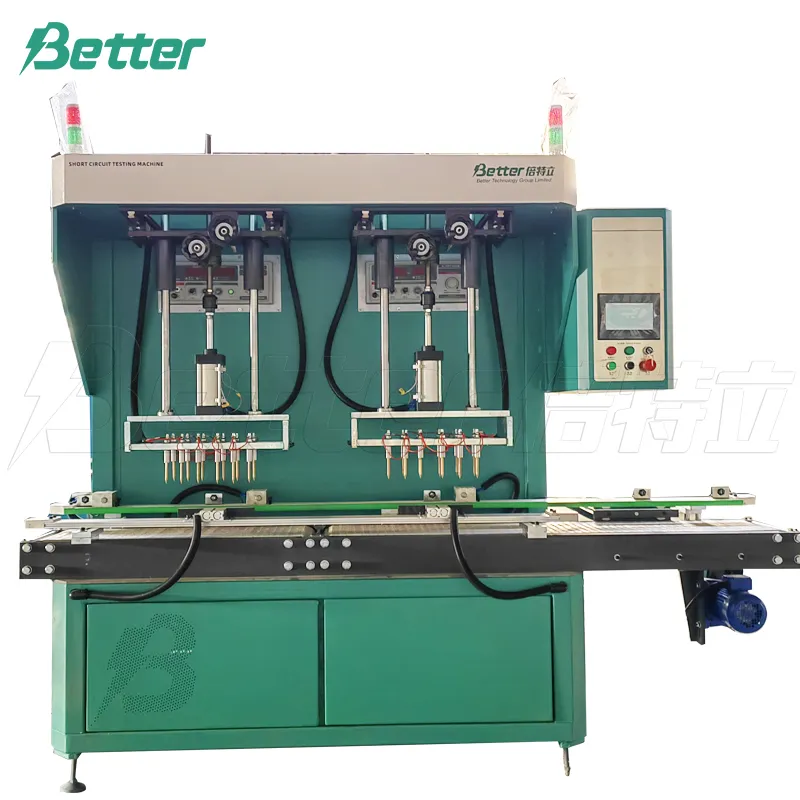
In lithium battery manufacturing, reliable plate short circuit detection makes a real difference in safety and efficiency. The Plate Short Circuit Testing Machine from Better-Tech stands out with its automatic operation using photoelectric sensors for precise battery positioning, adjustable testing voltage from 0 to 2000V, and high-sensitivity pulse high voltage checks that catch even minor insulation weaknesses or breakdown currents between positive and negative plates. It delivers a solid production capacity of 150 pieces per hour while automatically alarming on failures, pushing rejects aside, and routing qualified units forward—saving time and reducing human error compared with manual methods. For manufacturers focused on battery plate quality in lithium or similar lines, this equipment integrates smoothly into existing assembly flows, boosts overall yield, and helps deliver safer cells. Check it out at Plate Short Circuit Testing Machine to strengthen your short circuit prevention process.