Table of Contents
1. What Does an Acid Leveling Machine Actually Do
2. Why Manual Acid Leveling Causes Problems
3. Consistency Is the Real Advantage
4. Safety Improves When People Handle Less Acid
5. Speed and Cost Savings Add Up
6. Choosing the Right Acid Leveling Machine
What Does an Acid Leveling Machine Actually Do
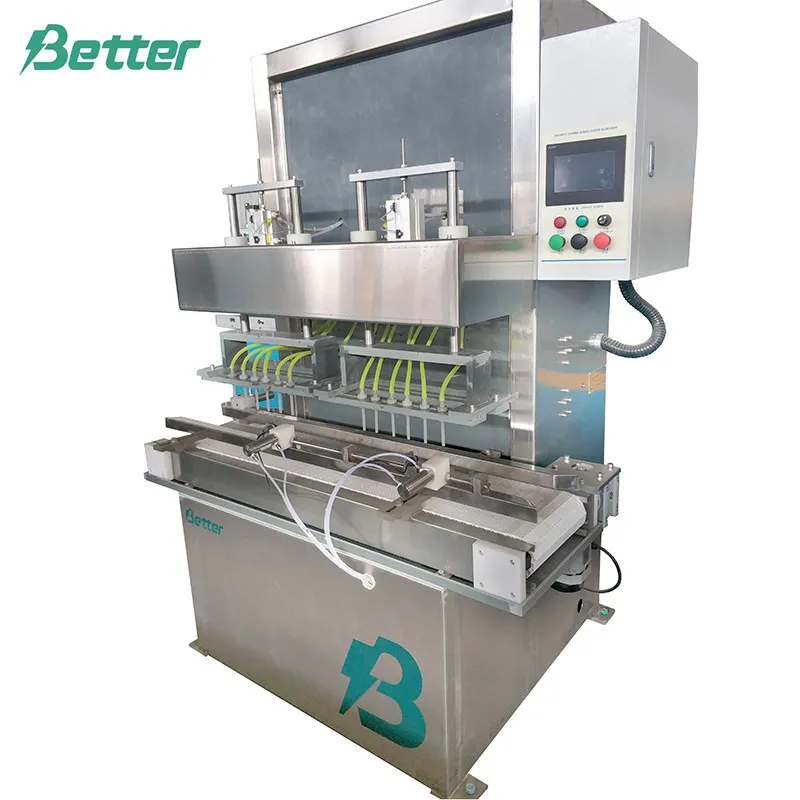
If you work in lead-acid battery production, you already know that acid levels inside each cell need to sit within a narrow range. Too much acid and the battery risks leaking or overflowing during use. Too little and the plates aren't fully covered, which shortens the battery's working life and hurts its performance. An acid leveling machine is built to solve exactly this problem — it automatically absorbs the redundant acid from each battery after formation, bringing the liquid level down to the standard required. Batteries are conveyed and positioned automatically, the machine draws out the excess acid using negative pressure suction, and the finished batteries move on to the next stage without anyone needing to touch them. It sounds like a small step in the larger production line, but getting it wrong creates problems that show up much later, sometimes only after the battery reaches a customer.
Why Manual Acid Leveling Causes Problems
Before automated equipment became common, workers checked acid levels by eye or with simple tools, then manually suctioned out the extra liquid. This approach depends heavily on the individual doing the work. One person might leave slightly more acid in a cell than another, and fatigue toward the end of a shift only makes the variation worse. Sulfuric acid solution is also corrosive and unpleasant to work with directly, so it's common for workers to rush the process or avoid getting close enough to check levels properly. The result is a batch of batteries with inconsistent acid levels, and inconsistency in a battery's electrolyte is one of the more common reasons behind early capacity loss or plate damage. Manual leveling isn't necessarily done carelessly, but it's simply hard for a person to repeat the same precise action hundreds of times a day without any drift.
Consistency Is the Real Advantage
This is where the comparison between manual work and machine leveling really matters. An acid leveling machine doesn't get tired, doesn't have an off day, and doesn't judge liquid level by eye. It suctions to a fixed, programmed level every single time, whether it's the first battery of the morning or the last one before the shift ends. For manufacturers, this means every battery leaving the line has essentially the same electrolyte level, which translates directly into more predictable capacity and a longer, more uniform service life across a production batch. If you've ever dealt with a batch of batteries where some units perform noticeably worse than others despite coming from the same line, inconsistent acid handling during manufacturing is often part of the explanation. Machines built with stainless steel components and PLC-controlled suction stations are designed specifically to remove that variability from the equation.
Safety Improves When People Handle Less Acid
Battery acid is diluted sulfuric acid, and direct contact with skin, eyes, or clothing can cause real harm. Anyone who has worked around it knows that even careful handling carries some risk, especially during repetitive tasks where a moment of inattention is all it takes for a splash to happen. Automating the leveling step doesn't eliminate acid from the workplace, but it dramatically cuts down how often workers need to be near open cells during this particular stage. The suction, measurement, and disposal of excess acid all happen within an enclosed, negative-pressure system rather than through manual siphoning. For companies managing workplace safety records or trying to reduce incident reports tied to chemical exposure, this is often one of the more tangible benefits of switching to automated equipment.
Speed and Cost Savings Add Up
Manual acid leveling is slow by comparison, and speed matters when you're running a production line with daily output targets. An automated machine can process batteries continuously, often handling two 12V batteries per station at a time, with output rates that manual labor simply can't match over a full shift. There's also a cost dimension that's easy to overlook — manual leveling tends to waste more acid because workers err on the side of removing extra liquid to avoid underfilling, or they leave slightly more than needed out of caution. A machine calibrated to precise volumes doesn't have that built-in margin of error, which reduces acid waste and the associated disposal costs over time. Labor costs factor in too, since one machine can effectively replace the ongoing manual effort of monitoring and adjusting acid levels across an entire shift.
Choosing the Right Acid Leveling Machine
Not every acid leveling machine is built the same way, and the right choice depends on your production volume, battery types, and existing line setup. Better Technology's acid leveling machine is designed around exactly the challenges described above — it uses 316L stainless steel construction for long-term corrosion resistance, negative-pressure suction for accurate and repeatable liquid level control, and a Mitsubishi PLC/HMI system that makes operation straightforward for line staff. The two-station layout keeps output steady without adding complexity, and components like AirTAC pneumatic parts and Schneider low-voltage apparatus are chosen for durability in continuous industrial use. For manufacturers looking to move away from the inconsistency and safety concerns of manual acid leveling, this machine offers a practical, well-built way to standardize the process while keeping production moving at pace.