Table of Contents
What Determines Runtime
The Simple Formula
Common Scenarios
Charging and Recharging
Battery Lifespan Matters Too
Making the Right Choice
What Determines Runtime
The short answer to how long a portable power station can power your devices is: it depends. But instead of leaving you with a vague answer, let's break down exactly what "it depends" means. A portable power station's runtime comes down to two numbers: the battery capacity measured in watt-hours (Wh) and the total wattage of everything you plug into it. Capacity tells you how much energy the battery holds—think of it as the size of the fuel tank. Wattage tells you how quickly your devices consume that energy—think of it as how fast the engine burns fuel.
Here's what you actually need to look for when you're shopping or planning: watt-hours (Wh) matter more than milliamp-hours (mAh) for any device bigger than a phone. A power station rated at 500Wh can theoretically deliver 500 watts for one hour, or 50 watts for ten hours. Simple enough. But in real life, you never get 100% of that number because of something called inverter loss. The power station has to convert stored DC power into the AC power that most household devices use, and that conversion wastes about 10-15% of the energy.
So the real-world rule of thumb is this: take the watt-hour rating, multiply by 0.85, and that's your usable energy. A 500Wh station gives you roughly 425Wh of actual run time. That's your starting point for any real calculation.
The Simple Formula
You don't need to be an engineer to figure out how long your portable power station will last. The formula is straightforward: Runtime (hours) = (Battery Capacity in Wh × 0.85) ÷ Total Device Wattage.
Let's walk through how to use this. First, find the wattage of each device you want to power. Most devices have a label or stamp that tells you either watts or amps and volts. If it says "120V 2A," multiply those: 120 × 2 = 240W. Add up the wattage of everything you plan to run at the same time. Then plug that total into the formula.
Say you have a 600Wh portable power station and you want to run a 60W laptop and a 10W phone charger at the same time—70W total. The math looks like this: 600 × 0.85 = 510 usable Wh. 510 ÷ 70 = about 7.3 hours. That's your realistic estimate.
One thing to watch out for: some devices have a higher "starting" wattage than their running wattage. Motors in mini-fridges or power tools can draw two or three times their normal wattage for a split second when they kick on. Your portable power station needs to handle that surge, or it won't start the device at all. Always check the peak output rating, not just the continuous rating.
Common Scenarios
Here's where the numbers translate into real life. A 300-500Wh portable power station is great for a weekend camping trip—it'll charge your phone dozens of times, run a laptop for a full workday, or power lights and a small fan through the night. Step up to 500-1000Wh, and you're looking at running a CPAP machine for one or two nights, keeping a mini-fridge cold for several hours, or powering a TV for an evening.
If you're thinking about a CPAP machine specifically, here's what you should know: most CPAP machines draw 30-60 watts, but using the heated humidifier pushes that closer to 60-80 watts. Using a DC converter cable instead of the AC plug can extend your runtime by 20-30% because you skip the conversion loss. Turning off the humidifier can cut power use by up to 65%, which could triple how long your portable power station lasts through the night.
For home backup during an outage, think about what you absolutely need to keep running. A router and modem might draw 20W total. A laptop is 60W. A few LED lights are 10W each. A 500Wh station could keep your internet and a laptop going for about 6-7 hours. Add a mini-fridge at 100W, and that same station drops to about 4 hours. The math tells you what's possible—and what isn't.
Charging and Recharging
Runtime isn't just about how long it lasts—it's also about how long it takes to get back to full. A portable power station can be recharged from a wall outlet, a car's 12V port, or solar panels. Wall charging is usually the fastest, often taking 2-5 hours depending on the station's size and the charger's wattage. Solar charging depends entirely on how much sun you get and how many panels you have—anywhere from 2 hours with a powerful setup to 6+ hours with a single small panel.
Here's a feature that matters more than you might think: pass-through charging. This lets you power your devices from the portable power station while the station itself is being recharged. During a power outage, you can keep your router and laptop running while the station pulls in power from a solar panel or generator. Not all portable power stations support pass-through charging, so if this matters to you, check the specs before you buy.
Charging speed also affects your overall experience. Some stations can recharge from 0 to 80% in under an hour with fast-charging technology. Others take half a day. If you're planning to use solar regularly, pay attention to the maximum solar input wattage the station accepts—higher input means faster charging when the sun is out.
Battery Lifespan Matters Too
Runtime per charge is one thing. But how many times can you charge it before the battery starts losing capacity? That's the other half of the "how long" question. A portable power station isn't a disposable device—you're making an investment that should last years.
The battery chemistry inside makes all the difference. Older lithium-ion batteries typically last about 500-800 charge cycles before their capacity drops to 80%. Lithium iron phosphate (LiFePO4) batteries, on the other hand, can last 3,000 cycles or more—that's roughly 10 years of daily use. The trade-off is that LiFePO4 batteries are slightly heavier for the same capacity, but for most people, the longevity is well worth the extra weight.
To get the most life out of your portable power station, keep the battery between 20% and 80% charge when possible, and use fast-charging features sparingly. Extreme temperatures—both hot and cold—can also shorten battery life. Store it in a cool, dry place when you're not using it, and try to recharge it at least every few months to keep the battery chemistry healthy.
Making the Right Choice
When you're choosing a portable power station, start with what you actually need to power. List your devices, add up their wattage, and decide how many hours of run time you want. That gives you the minimum Wh capacity you need. Then add a buffer—real-world conditions like cold weather, older devices with higher draw, or simply wanting a safety margin mean you should aim for 20-30% more capacity than your calculation suggests.
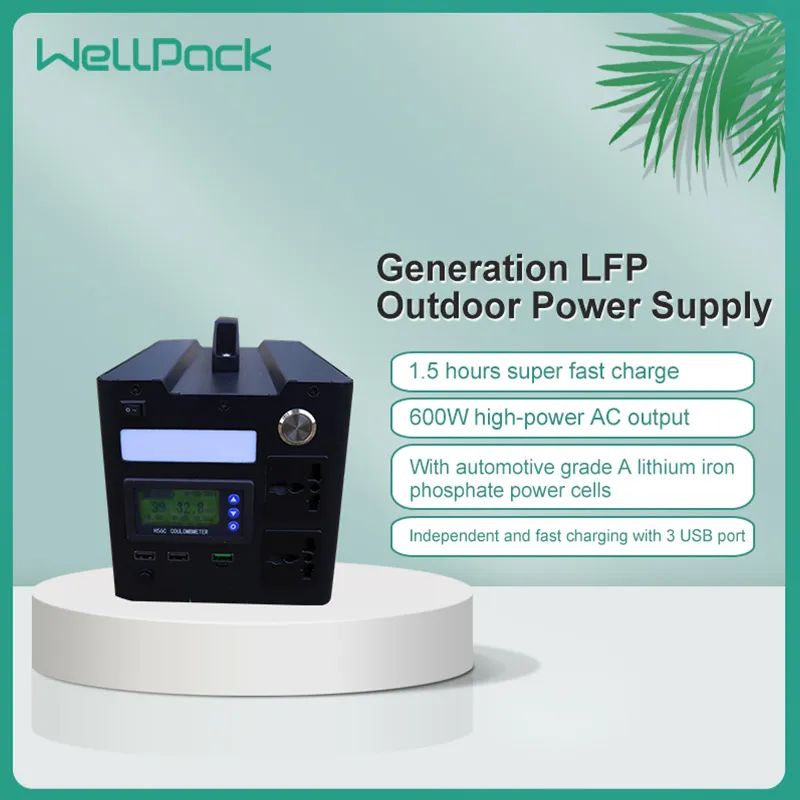
The Better-Tech solar panel portable power station for camping checks all the right boxes for anyone who needs reliable power on the go. With a 600W high-power AC output, fast charging that's three times quicker than comparable products, and support for external solar panel charging, it keeps your devices running when you need them most. The compact design—just 25cm long, 14cm wide, and 14.5cm high at 6.5kg—makes it genuinely portable without sacrificing capacity. Whether you're camping off-grid, preparing for emergency power outages, or need a reliable backup for work on the road, this station delivers the performance and versatility that makes it a solid choice. Small enough to carry, powerful enough to count on—it's the kind of gear that turns "I hope I have power" into "I know I have power."