What Is a Battery Separator and Why It Matters
2026-03-30 14:05Table of Contents
1. What Is a Battery Separator?
2. How Battery Separators Work in Lithium-Ion Batteries
3. Why Battery Separators Matter for Safety
4. Common Materials in Battery Separators
5. Issues with Battery Separators and What They Mean for You
6. Precision in Separator Manufacturing
What Is a Battery Separator?
A battery separator is a thin, porous sheet placed right between the positive and negative electrodes inside a lithium-ion battery. It keeps the two sides physically apart so they cannot touch and cause a short circuit, yet it lets lithium ions move freely through its tiny pores during charging and discharging. Without this layer, the battery simply would not function safely or at all.
In everyday terms, it acts like a selective filter in the heart of the cell. You encounter battery separators indirectly every time you use your phone, laptop, power tool, or electric vehicle. They are what make modern rechargeable batteries reliable enough for daily life and work.
How Battery Separators Work in Lithium-Ion Batteries
Inside a lithium-ion battery, the separator sits soaked in electrolyte solution. When the battery charges, lithium ions travel from the positive electrode through the separator’s pores to the negative electrode. During discharge, the ions move back the other way, releasing energy to power your device. The separator blocks electrons from crossing directly — that electron flow happens outside the cell through the circuit instead.
The pores must be small enough and uniform to control ion movement precisely. Too large or uneven, and unwanted particles or dendrites can form and bridge the electrodes. The material also needs to stay stable in the harsh chemical environment of the electrolyte while staying thin enough — usually between 12 and 30 micrometers — to keep internal resistance low and energy density high.
This balance of insulation and conductivity is what determines how efficiently a battery stores and releases power.
Why Battery Separators Matter for Safety
Safety starts with the separator because it is the main barrier against internal short circuits. If the separator fails, the electrodes can touch, heat builds up rapidly, and thermal runaway can follow. A well-designed separator includes a shutdown feature: at a certain temperature the pores close, stopping ion flow and preventing further reaction before things get dangerous.
In real-world use, this matters when batteries face high temperatures, overcharging, or physical stress. Users often notice swelling, reduced runtime, or unexpected shutdowns when separator performance drops. A strong separator helps batteries last longer, hold more charge cycles, and stay safe even under heavy daily demands like fast charging or high-power applications.
Manufacturers focus on separator quality because even small defects can turn into big reliability problems later.
Common Materials in Battery Separators
Most commercial lithium-ion battery separators use polyolefin materials, primarily polyethylene (PE) and polypropylene (PP). PE offers a lower melting point for quick shutdown protection, while PP provides higher thermal stability. Many separators combine layers of both for the best of each property.
Some advanced versions add ceramic coatings to improve heat resistance and reduce shrinkage at high temperatures. Other types include nonwoven fabrics or inorganic composites for specialized needs, such as higher porosity or better electrolyte absorption.
Each material choice affects cost, mechanical strength, wettability by the electrolyte, and overall battery life. The right material helps balance performance, safety, and production economics in large-scale battery manufacturing.
Issues with Battery Separators and What They Mean for You
Separators can degrade over time from heat, chemical reactions with the electrolyte, or mechanical stress during repeated charge cycles. When this happens, ion flow becomes uneven, internal resistance rises, and capacity fades faster than expected.
In manufacturing, tiny defects like pinholes, folds, or misalignment can slip through if equipment is not precise. These lead to batteries that underperform or fail safety tests, resulting in higher scrap rates and inconsistent product quality. For end users, this translates to shorter battery life, unexpected power loss, or concerns about overheating in devices they rely on every day.
Understanding these issues helps when evaluating battery options or troubleshooting performance drops. It also explains why consistent separator quality is a top priority for any producer aiming for dependable lithium batteries.
Precision in Separator Manufacturing
Building a high-quality battery requires exact handling of the separator during assembly. The material must be fed, cut, wrapped around electrode plates, and stacked without wrinkles, misalignment, or contamination. Any error at this stage affects the final cell’s safety and efficiency.
Modern production lines use automated equipment to maintain tight tolerances on alignment, tension, and speed. This precision directly improves yield, reduces waste, and ensures every battery meets performance standards. For companies in the battery supply chain, investing in reliable assembly technology is one of the most practical ways to deliver better products to customers who depend on long-lasting, safe power sources.
If you work in battery manufacturing or are researching ways to improve your production process, the right tools make a measurable difference in output quality and operational efficiency.
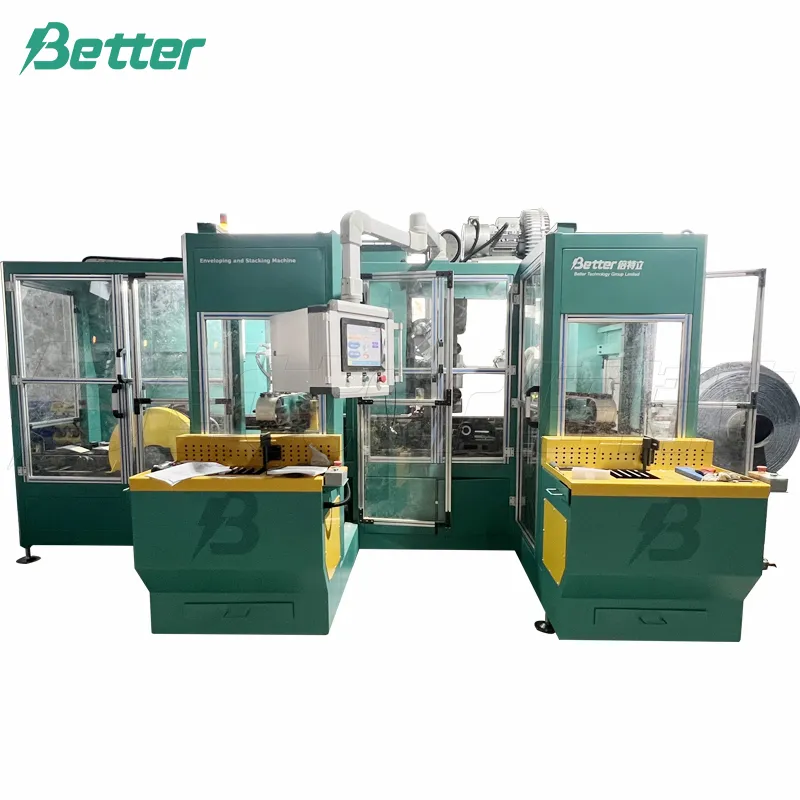
In battery production, having reliable equipment like the Separator Enveloper & Stacker from Better Tech can make a real difference. This machine handles enveloping and stacking for PE, AGM, and fiberglass composite separators with speeds up to 150 pieces per minute for PE and 120 for AGM. It features dual unwinding turntables, side-brushing of plate lugs, wrapping options, heat shrinking, and compression for plate groups. With a scrap rate and unqualified rate both ≤0.1% and alignment tolerance ≤2mm after encapsulation, it delivers the precision needed for consistent, high-quality battery cells. Powered by Omron PLC, Panasonic servo motors, and robust pneumatics, it supports plate sizes from 86–160 mm length and 20–120 mm group thickness while minimizing manual intervention. For B2B manufacturers focused on efficiency, safety, and low waste, this equipment is a practical upgrade that helps produce better-performing lithium batteries at scale.