


How Intercell Welding Builds Stronger Car Batteries
2026-01-21 11:43Contents
1. The Role of Connections in Car Batteries
2. What Exactly is Intercell Welding?
3. How Intercell Welding Differs from Older Methods
4. Step-by-Step: The Intercell Welding Process
5. Why Strong Intercell Connections Improve Battery Life
6. Reducing Resistance for Better Performance
7. Handling Common Battery Failure Points
8. Modern Equipment for Reliable Intercell Welding
The Role of Connections in Car Batteries
Most car batteries are lead-acid batteries made up of several individual cells connected together inside a single case. Each cell produces about 2 volts, and linking them in series gives you the standard 12 volts needed to start an engine and power accessories. The connections between these cells—known as intercell connections—carry the full current the battery delivers. If those connections are weak or poorly made, the battery struggles to perform, especially under high load like cold starts or running heavy electrical systems.
People often notice problems like slow cranking, dim lights, or a battery that dies faster than expected. Many times, the root cause traces back to how well the cells are joined. Strong, reliable intercell connections make the difference between a battery that lasts years and one that fails prematurely.
What Exactly is Intercell Welding?
Intercell welding is the process of permanently joining the positive terminal of one cell to the negative terminal of the next through holes in the battery partition walls. This creates a solid electrical path using molten lead that cools and hardens into a fused metal bond. Unlike mechanical connections, intercell welding forms a single continuous piece of metal across the join.
In modern car battery manufacturing, intercell welding has become the standard approach because it delivers consistent, low-resistance connections that hold up under vibration, temperature changes, and heavy current flow. The term "intercell welding" specifically refers to this through-partition welding technique that ties the internal cells together securely.
How Intercell Welding Differs from Older Methods
Older batteries often used cast-on-strap (COS) methods or simple lead burning with a torch. These approaches connect cells by melting lead straps over the cell terminals, but the joins can develop cracks, higher resistance, or incomplete fusion over time. Manual torch work also varies depending on the operator's skill, leading to inconsistent quality.
Intercell welding, especially when done with controlled equipment, produces cleaner, deeper penetration and more uniform bonds. The result is lower internal resistance and better mechanical strength. Manufacturers switched to intercell welding because it reduces failure rates and improves overall battery reliability in real-world driving conditions.
Step-by-Step: The Intercell Welding Process
The process starts with the battery case already filled with assembled plates and separators, and electrolyte may or may not be added yet depending on the production line. Holes are molded into the partition walls between cells. Workers position the battery precisely under the welding station.
Electrodes or welding tips come down and contact the terminal posts on both sides of the partition. A controlled burst of electrical energy melts the lead, which flows together through the hole. The current is carefully managed—usually with constant energy or constant current settings—to achieve full fusion without burning through or creating voids. Once the melt solidifies, the intercell connection is complete and permanent.
Modern intercell welding machines handle multiple connections at once or move sequentially across the battery for efficiency. The whole cycle for one battery typically takes just seconds when automated properly.
Why Strong Intercell Connections Improve Battery Life
Good intercell welding directly extends battery service life. A solid fused joint resists the constant vibration from driving, preventing micro-cracks that gradually increase resistance. Higher resistance generates more heat during charging or discharging, which accelerates plate corrosion and sulfation—two main causes of battery aging.
Well-welded intercell connections also maintain lower internal resistance throughout the battery's life, so it delivers full power longer and recharges more efficiently. Drivers notice longer intervals between replacements and fewer unexpected failures.
Reducing Resistance for Better Performance
Internal resistance is a key specification for any car battery. Lower resistance means the battery can push out higher current quickly—critical for starting engines in cold weather or powering high-draw accessories. Intercell welding consistently achieves resistance values below 0.5 mΩ per connection, far better than many traditional methods.
When resistance stays low, less energy is wasted as heat, and voltage drop under load is minimized. The starter motor turns faster, lights stay brighter, and the alternator doesn't have to work as hard to recharge the battery. All of this translates to smoother electrical performance in daily driving.
Handling Common Battery Failure Points
One of the most common failure modes in lead-acid batteries is open or high-resistance intercell connections. Vibration loosens mechanical joins, and thermal cycling causes expansion and contraction stress. Poor welds can develop hot spots that melt further or oxidize internally.
Quality intercell welding eliminates most of these risks. The fused metal bond flexes with the case without breaking, and the absence of interfaces prevents oxidation. Batteries with properly welded intercell connections rarely fail due to internal breaks, shifting the typical failure mode to normal plate wear instead of premature connection problems.
Modern Equipment for Reliable Intercell Welding
Today's battery production lines use advanced intercell welding machines that combine precision control with practical workflow. Semi-automatic systems strike a good balance for many manufacturers: the operator positions the battery and starts the cycle with a footswitch, then the machine handles the welding automatically with computer-controlled parameters.
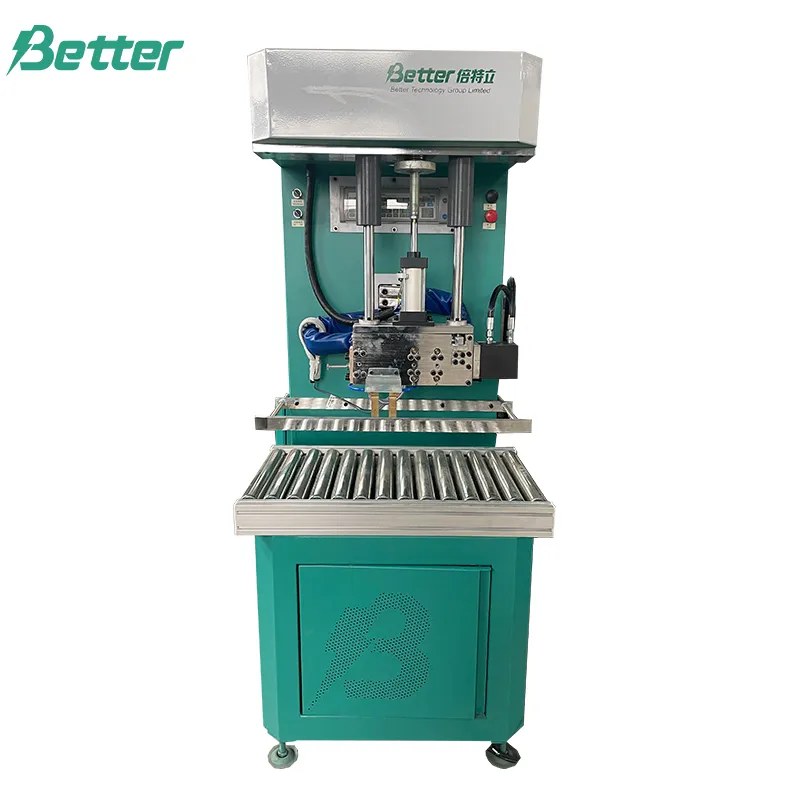
A strong option in this category is the semi-automatic intercell welding machine from Better-Tech designed specifically for car batteries in the 36Ah to 200Ah range. It uses hydraulic pressure and MIYACHI PLC control for accurate, repeatable welds. The system automatically compensates for power fluctuations, sets parameters digitally, and includes durable alloy welding tips that last longer than standard ones. With constant energy and current modes, it produces clean, void-free connections while keeping operation straightforward and efficient. For manufacturers looking to improve quality and consistency in mid-to-high volume production, this machine offers reliable performance without the complexity of full automation.